Mini Caps
Automated high throughput cell assays with P3 level 24/7 pathogen testing
Epidemic outbreaks of Bird flu Influenza, Zika and recently Covid-19 have made it clear we need fast and flexible research capacity to develop assays for new pathogenic agents and screen for molecular targets with therapeutic activity.
Automated high throughput screening on cell culture assays allows for hit discovery with functional endpoints on a wide variety of diseases from oncology, immunology, cardiology, metabolism and pathogenic infections. A compact platform provides a cost-effective way of accessing high throughput screening, also in the appropriate biosafety conditions for pathogen toxicity assays.
The CAPS-IT platform demonstrates a proven technology where large libraries of compounds were screened efficiently for anti-viral activity across multiple projects. The MiniCaps system provides similar capability in a scalable format tailored to your needs, requirements and budget.
MiniCaps automated pathogen assay platform

Nucomat and MBraun have engineered a compact and flexible automated platform for 24/7 cell culture based pathogen assays and screening inside a top notch sealed enclosure at the highest standards of biosafety. Building on the experience from the larger Caps-IT platform for automated P3+ pathogen screening, at the Rega Institute for infectious diseases at KULEUVEN (Belgium), the lab staff can operate a P3+ process from a more convenient P2 work environment to work with new or poorly characterized pathogens.
Your benefits
- High throughput cell based assays
- Compact and cost effective P3 lab solution, also scalable at P2 biosafety level.
- Operator and lab safety
- Reliable and repeatable hands-off 24/7 operation
- Traceable data; 21 CFR part 11 option
- Proven technology, see reference list below.
MiniCaps Features
- 2 autonomous automated microplate cell incubators: 120 microtiter plates each
- Standard ANSI-SLAS 96 and 384 well format
- Maintain and process cell cultures at 30 ºC to 42ºC, 5% CO2, humidity.
- Sealed back window for safe visual inspection.
- Autonomous disinfection cycles.
- Liquid handler station with a configurable 1m deck.
- Microplate reagent dispenser
- 96/384
- Plate delidder
- Plate washer
- 96/384
- Buffer exchange
- ELISA assays
- Multimode plate reader
- 96 and 384 well
- Colorimetry
- Fluorescence
- Luminescence.
- High Content Imager: imaging and analysis in microtiter plates
- Epifluorescence
- Confocal option
- Custom protocols in imager software
- Stained and live cell assays.
- Safety lock: decontamination to import and export materials in closed ISO cages. (P3)
- Space saving overhead cartesian robotics
- Reproducible operation
- Glove Box access for manual actions.
Central web-based software
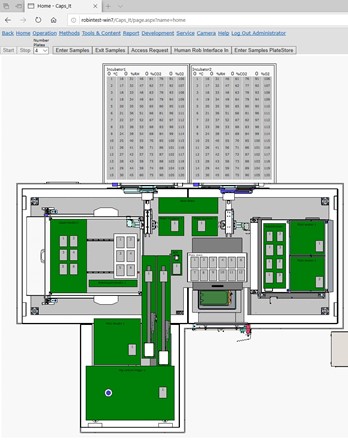
- robin scheduler, Nucomat’s proprietary real-time event-driven scheduling software
- Priority scheduling.
- Continuous process optimisation
- Web interface:
- Run samples
- Real-time live status view
- Edit protocols
- Error handling, smart retry, run recovery.
- Sample Database
- Barcode ID sample tracking from registration to result
- Event logging
- Data import, export and reporting, LIMS compatible.
- Offline reader data handling
- Database result links.
- Remote operation
Assay procedures and platform flexibility
- Flexible multi-assay operation
- Example protocols for Seeding, incubation, harvesting, plate replication, reading, HCI monitoring, and end-point testing.
- Edit or build your own protocols.
- Run multiple protocols in parallel.
- Switch plates from one protocol to another.
- Replicate plates for multiple readouts.
- Maintain cell culture while decontaminating platform.
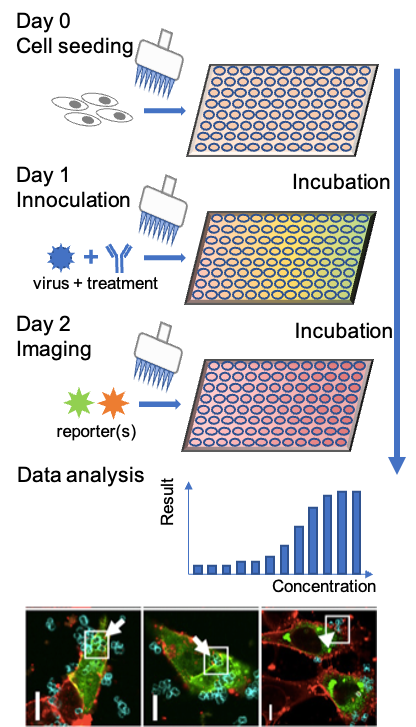
Validated technology and industry collaborations – Publication references :
- Laporte et al. A coronavirus assembly inhibitor that targets the viral membrane protein, Nature (2025). https://doi.org/10.1038/s41586-025-08773-x
- Rosales-Rosas et al., The antiviral JNJ- A07 significantly reduces dengue virus transmission by Aedes aegypti mosquitoes when delivered via blood- feeding, Sci. Adv. 10, eadr8338 (2024).
- Li et al. Multiplexed multicolor antiviral assay amenable for high-throughput research, Nature Communications (2024) 15:42. https://doi.org/10.1038/s41467-023-44339-z
- Chiu et al. Development of a robust and convenient dual-reporter high-throughput screening assay for SARS-CoV-2 antiviral drug discovery, Antiviral Research 210 (2023) 105506. https://doi.org/10.1016/j.antiviral.2022.105506
- Wang, et al. Phenotypic High-Throughput Antiviral Assay for the Discovery of Rabies Virus Inhibitors. Viruses (2023) 15, 2292. https://doi.org/10.3390/v15122292
- Saul et al. Anticancer pan-ErbB inhibitors reduce inflammation and tissue injury and exert broad-spectrum antiviral effects. J Clin Invest. (2023) 133 (19):e169510. https://doi.org/10.1172/JCI169510
- Zaliani et al. Cytopathic SARS-CoV-2 screening on VERO-E6 cells in a large-scale repurposing effort. Nature Scientific Data (2022) 9:405. https://doi.org/10.1038/s41597-022-01532-x
- Vanmechelen et al. Identification of novel Ebola virus inhibitors using biologically contained virus. Antiviral Research 200 (2022) 105294. https://doi.org/10.1016/j.antiviral.2022.105294
(non-exhaustive list of publications with reference to screening on CAPS-IT, Rega Institute, KU Leuven)